
Recent Magenta Renewables assignments have given us pause to revisit some of the fundamental tenets of the floating offshore wind (FOW) sector. As the technology stands on the cusp of commercialisation, with major pathfinder projects in both Europe and China forecast to take FID in 2027, there is still a huge amount to play for in terms of design, innovation, process and efficiency.
We consider here some of the key topics that will play out as the project pipeline matures. Developers, investors, government agencies and suppliers will be watching the next batch of projects with keen interest as the sector looks to validate projections with practical evidence.
Europe is biased towards floating
FOW has a substantial global pipeline of 183 GW. Europe accounts for 64% (117 GW) of this capacity, compared with 37% of the overall offshore wind pipeline, including fixed and floating projects at both operational and development stages.
For reference, Europe is characterised by relatively high labour costs, strong offshore O&G and wind track records in the North Sea, and a general policy ambition to de-risk supply chains and improve industrial independence.
Industrialisation is the key to commercially successful FOW
Our extensive experience tells us that it’s all about engineering and planning for scale. For the technology to be cost-effective, serialisation of foundation fabrication and assembly is essential - production runs must be sufficiently large to spread the fixed costs of the design, facilities, equipment and supporting assets.
This holds true for both steel and concrete foundation designs, but in different ways. Most steel designs rely on as much pre-fabrication as possible in low-cost global hubs, with efficient final assembly at a port local to the project. Concrete foundation design proposals may use techniques such as slipforming (as widely used in general construction) to rapidly extrude a structural profile. Concrete foundation structures are generally larger and heavier than steel foundations per MW, and are hence more suited to local fabrication, placing different requirements on ports and providing greater opportunities for local suppliers.
Could concrete help bring down cost?
A major choice that all projects need to eventually make is the principal foundation material (generally committed at the EIA stage or in FEED). As with any offshore infrastructure project, the answer to ‘which technology is best’ is likely to be a nuanced answer, i.e. it’s a mixture, depending on many factors such as local supply chain, port capability, metocean conditions and preferred project logistical approach.
Steel is considered the incumbent material for offshore applications, but there are a healthy number of concrete design proposals in the running.
Cost is obviously a huge topic, but also embedded emissions (including end-of-life / repowering plans) and the overall design / supply / logistical risk profile.
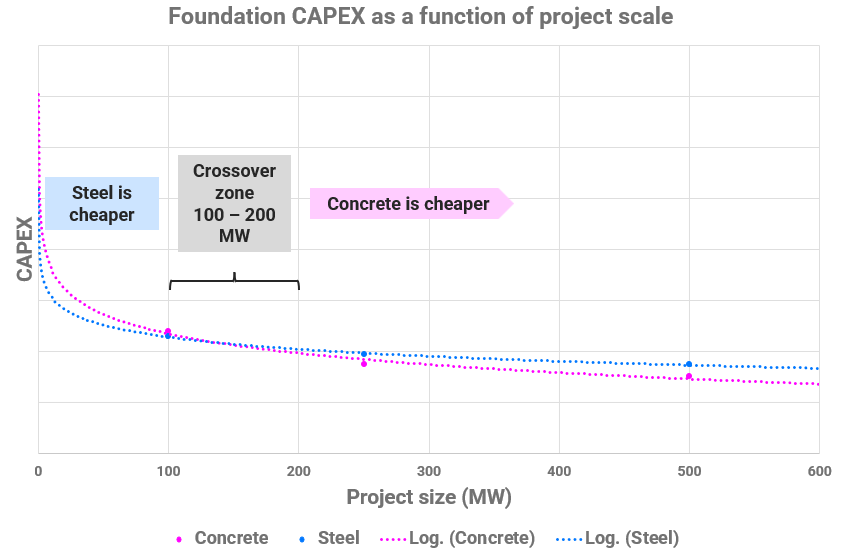
Recent foundation CAPEX modelling by Magenta Renewables found that, for two comparable 17 MW semisubmersible designs, there is a crossover at 100 – 200 MW where concrete becomes cheaper. This is due partly to the relatively larger fixed costs of setting up the concrete fabrication line.
Source: Magenta Renewables Consultancy
This doesn’t however tell the complete story, since mooring costs also need to be factored (generally larger for heavier concrete foundations). A review of several recent industry studies still found that, at the project level, concrete generally appears slightly cheaper than steel at full project scale (500 MW+).
The onus is on proponents of concrete technology to demonstrate this, as well as proving the technical integrity of concrete in FOW structures by obtaining the relevant design certifications and body of operational evidence. Fabrication and assembly of concrete foundations at scale also requires large, substantial ports.
Embedded CO2 is a complex question, being sensitive to material choices, quantities and supply routes (as well as many other project features). Magenta Renewables modelling using the recently published Carbon Trust standardised tool for Product Carbon Footprinting found that in the worst cases (i.e. low recycling / process efficiency), raw materials emissions for steel foundations may have nearly doubled the emissions of equivalent concrete foundations. When higher recycling is introduced, footprints for both materials can be significantly reduced.
The next wave of 100 MW+ scale pathfinder projects are currently focussed on steel
The upcoming projects forecast for construction (other than small-scale demonstrators) are generally using steel foundations. In the UK, the four floating projects that have been awarded CfD contracts across auction rounds AR4-7 have all selected steel.
Beyond these four projects however, in the UK 18% (5.2 GW) of FOW development projects have chosen or favour concrete, with a further 54% (15.6 GW) undecided or unknown.
Upcoming commercial FOW projects in China and South Korea appear to also favour steel foundations, which is consistent with the large steel industries in those countries.
Conclusion
In the coming years, FOW must clearly demonstrate both cost and technical risk reduction. China is forging ahead, and Europe (particularly the UK, France and Norway), South Korea and Japan have pipelines backed by industrial policy.
Performance at scale is key. Both steel and concrete have their proponents, but it is still very much a two-horse race. Concrete may yet be the answer for European projects wanting to reduce exposure to pre-fabricated steel prices and promote local content by integrating foundation fabrication and assembly locally, but there is much to demonstrate still in terms of design readiness and realisation of serial production.
In the UK, the steel industry has been in decline for decades, so concrete is an interesting opportunity for boosting local FOW foundation production. A 100 MW+ scale concrete project would be a useful counterpoint to the handful of imminent projects planning to use steel foundations.
One thing is clear: the industry is absolutely depending on the next wave of projects to provide the required evidence to unlock the larger pipeline.
