Understanding offshore wind industrial hubs
Hubs of economic activity, jobs, prosperity and technical excellence exist all around us. But, how do they come to be?
What policy and governance mechanisms, what investments and financial models, and what supply chain incentives were used to create these hotspots of industrial leadership?
Under a project on behalf of Ireland’s Western Development Commission (WDC) and supported by Offshore Construction Associates (OCA), we undertook to answer these questions and provide actionable advice to support industrial policy on the West Coast of Ireland.
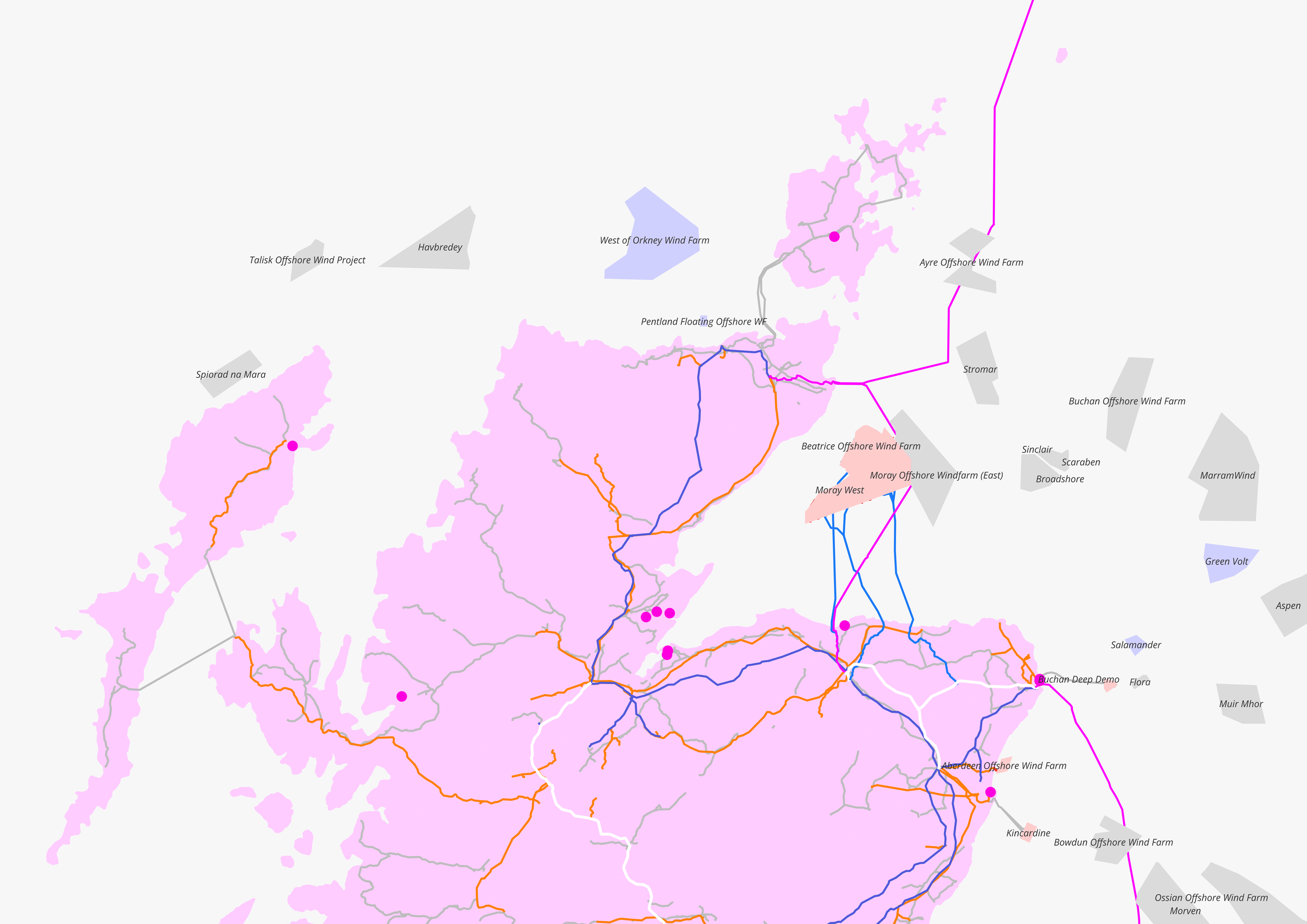
A map showing offshore wind and electrical infrastructure in northern Scotland, a hub of offshore wind industry and one of the case studies used in this project.

Our approach
We brought together four case studies, representing different governance models, infrastructure baselines, and stages of market maturity. From each of these, we identified patterns and applicable lessons in the sequencing of policy, incentives and investment.
The North of Scotland
The Humber Region (UK)
Atlantic France
Germany
Outcomes
This work (based on the above examples - all with ambitious offshore wind programmes and differing levels of buildout) highlighted that successful offshore renewables programme outcomes depend generally on early, coordinated public planning across infrastructure, policy and skills.
There is evidence that aligning grid investment, port capability and long‑term O&M planning ahead of construction helps avoid constraints and allows projects to proceed. In other words - system level co-ordination becomes critical when dealing with many large projects that depend on common infrastructure and resources.
We interpreted these lessons for Ireland, giving WDC insight into how Ireland’s emerging offshore framework differs from more mature markets, and what needs to be addressed early to avoid structural constraints later.